If your meeting room sounds like a swimming pool and you can hear every phone call two desks away, the problem is echo, and it is one of the most common complaints we get asked to fix in commercial offices. The good news is it is solvable. The thing most people get wrong is what actually causes it.
Echo is not a sign your walls need more insulation. Wall and floor insulation controls sound moving between rooms. Echo is sound bouncing around inside a room. They are two different problems, measured two different ways, and fixed with two different products. Pour money into the wrong one and the room still rings.
Echo is reverberation, and reverberation is an absorption problem
When someone talks in a hard room, the sound hits the ceiling, the glass, the floor and the plasterboard, and most of it bounces straight back into the room. Those reflections pile up on top of each other and smear speech into a wash of noise. That is reverberation, and you hear it as echo.
The fix is to stop the reflections by putting soft, sound-absorbing surfaces into the room so the sound energy is soaked up instead of thrown back. That is the whole game. Everything below is just where and how much.
STC and IIC will not fix echo. NRC will
This is the distinction that trips people up, so it is worth being clear.
STC (Sound Transmission Class) and IIC (Impact Insulation Class) measure how well a wall or floor stops sound passing from one space to the next. They are about soundproofing and noise between apartments or tenancies. They do nothing for echo inside a room.
NRC (Noise Reduction Coefficient) measures how much sound a surface absorbs. That is the number that matters for echo. If you are buying anything to quieten a room, NRC is the figure on the data sheet to look at.
What NRC actually means
NRC runs on a simple scale from 0 to 1. A surface with an NRC of 0 reflects all the sound that hits it. A surface with an NRC of 1 absorbs all of it.
Hard finishes are close to the bottom. Glass, concrete, plasterboard and a polished floor all sit around 0.05, which is why a fitout full of those materials rings. A purpose-built acoustic panel or ceiling tile sits up around 0.85 to 1.0. So replacing even a portion of those hard surfaces with high-NRC material is what takes a room from echoey to calm.
You do not need to cover everything. You need enough absorptive area, in the right places, to bring the reflections under control.
Why modern offices echo more than they used to
The look everyone wants now is the look that echoes. Open-plan floors with no dividing walls. Exposed concrete or bare metal soffits instead of a soft suspended ceiling. Hard floors instead of carpet. Lots of glass. Minimal soft furnishing.
Every one of those choices strips absorptive surface out of the room. The space looks sharp and reflects sound like a drum. It is not a building fault, it is a design trend, and it is exactly why retrofit acoustic treatment has become such common work.
What actually fixes it
You add absorption back, usually in this order of impact:
- The ceiling first. It is the biggest uninterrupted surface in most offices and the one bouncing the most sound back down onto people. Acoustic ceiling panels, rafts or baffles hung off an exposed soffit do the heavy lifting. Products like Autex Quiet Space panels and ceiling rafts are built for exactly this.
- The walls next. Wall-mounted acoustic panels pick up the reflections the ceiling does not. Asona Fab Wall fabric-wrapped panels are the option when the finish has to look deliberate, like a boardroom or a reception, because they perform acoustically and read as a design feature rather than a fix.
- Targeted spots. Workstation screens and freestanding panels around call-heavy zones knock down the desk-to-desk bleed that drives people up the wall.
The point is to choose high-NRC product and put enough of it where the reflections actually are, rather than scattering a few panels around and hoping.
The hard part is installing it in a working building
Most echo treatment goes in late, often into a space that is already finished or even occupied. That is where the job gets technical. The panels and rafts have to be set out cleanly, fixed to hold long term, and dressed around live ceiling services, sprinklers, lighting, HVAC and the existing ceiling grid, without marking the finished surfaces around them. Done badly it looks like an afterthought bolted to the ceiling. Done properly it looks like it was always meant to be there, and it tests to the absorption the acoustic engineer specified.
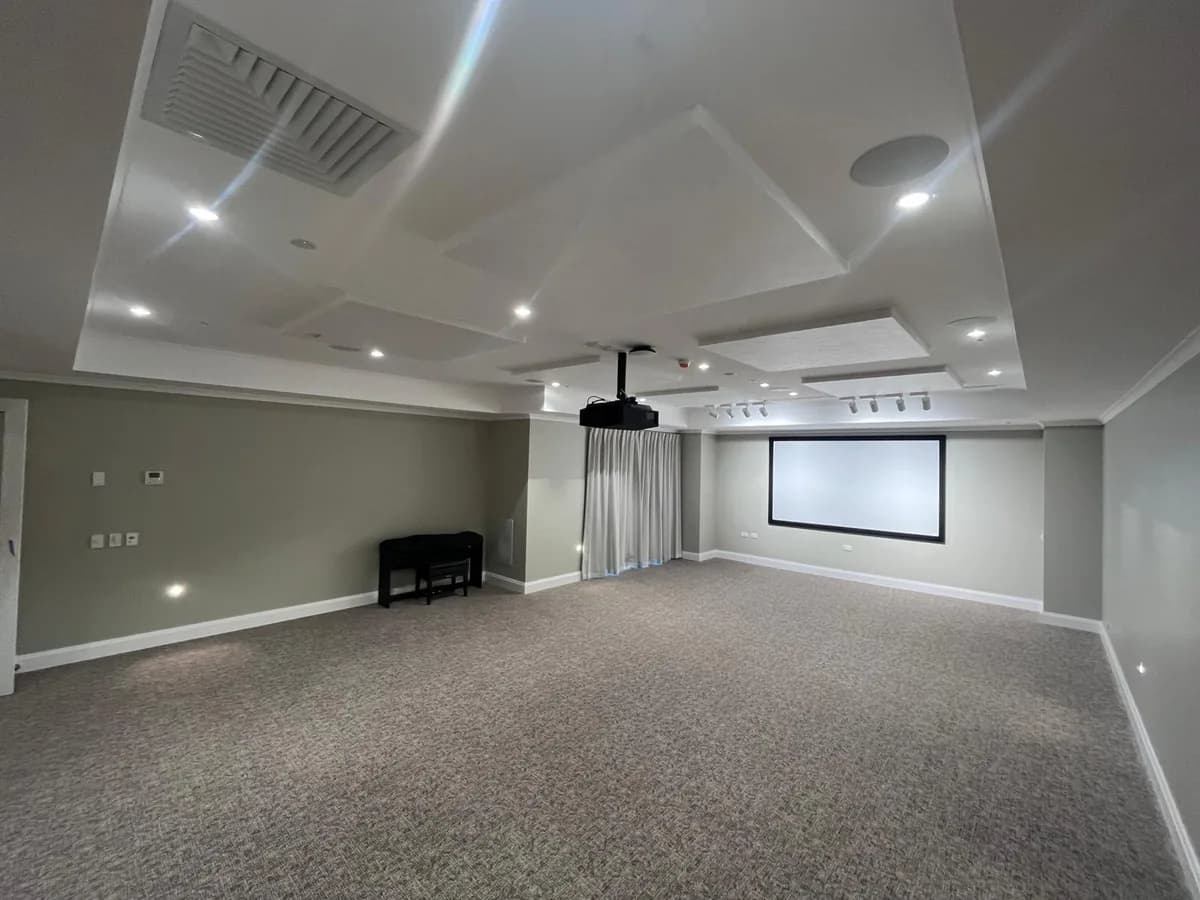
We recently completed the acoustics in a medium-sized cinema at a retirement village in Whangarei, with the addition of six Autex Quiet Space panels, placed uniformly across the ceiling to absorb the audience sound reflecting back off it. The space already had soft floor coverings and a hanging curtain, and the extra Quiet Space made a real difference to the viewing experience: this product has an NRC of 0.85 to 1.00, meaning the panels absorb 85 to 100 percent of the sound that hits them.
Another situation we get asked to help with is a failing intertenancy acoustic test. When you construct a larger apartment building or multi-unit development, part of getting your Code Compliance Certificate (CCC) is the intertenancy walls and an on-site STC and IIC soundproofing test. When those tests fail, it can be costly and time-consuming to find the issue. In one case we were asked to consult on, at an apartment building in Northcote on Auckland's North Shore, we found the vertical risers next to the bedrooms were creating a flanking path, carrying sound from the basement up into the apartments. These cupboard-sized risers were amplifying the noise all the way to level 6 as it bounced up the shaft. Our solution was to direct-fix uniform squares of Mammoth carpark panels (NRC 0.85) inside the risers, absorbing the sound at regular intervals. It was a cost-effective, time-efficient fix to a potentially troublesome problem, and the next round of acoustic testing passed.
This is the finishing-stage acoustic work we do regularly: reading the spec, getting the right product, and installing it around everything else that is already in the room.
A quick way to brief it
If you are scoping echo treatment, three things get you a useful quote fast: the room and roughly its size, what the surfaces are now (hard floor, exposed soffit, lots of glass), and what the space is for (calls, meetings, reception, open plan). From there we can recommend the product and the coverage and give you a price.
We install acoustic panels, ceiling panels and fabric-wrapped wall systems for commercial offices across Auckland and the wider North Island. If a space in your building rings, send us the room and we will do our best to offer a solution that works for your space.