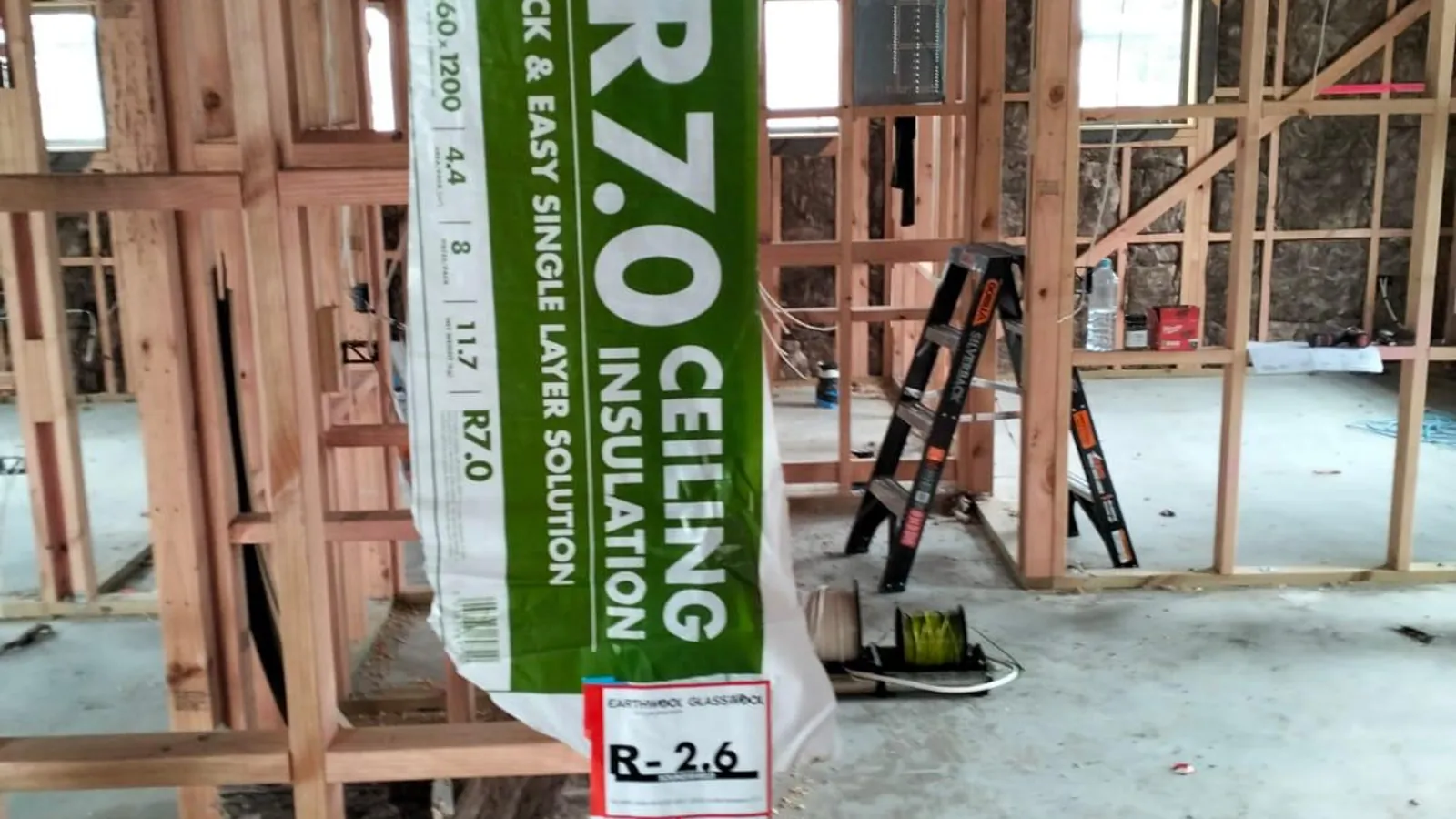
R-value is the number every insulation conversation orbits around. Bigger is better, except when it isn't, and the install quality matters more than the label on the bag.
Here's what R-value actually measures, how it interacts with the New Zealand Building Code, and what to watch for on your next project.
What R-value measures
R-value is a measure of how well a material resists the flow of heat. The higher the R-value, the slower the heat moves through the assembly, keeping a building warmer in winter and cooler in summer.
It's measured per assembly: R3.6 ceiling, R2.0 wall, R2.5 underfloor. Sometimes the rating is for the material alone (called R-value of the product). More often, what matters is the construction R-value: the performance of the whole assembly with framing, air gaps, and linings included.
H1 compliance: what changed
Under Clause H1 of the New Zealand Building Code (Energy Efficiency), every new building has to meet minimum construction R-values based on its location.
The big change came in 2022–2023. New Zealand was split into six climate zones (up from three), and minimum R-values were lifted significantly. For ceilings:
- Climate Zone 1 (Auckland and the upper North Island): R6.6 minimum
- Climate Zone 2 (most of the North Island): R6.6 minimum
- Climate Zone 3 (Wellington, lower North Island): R6.6 minimum
- Climate Zone 4 (most of the South Island): R6.9 minimum
- Climate Zone 5 (Otago, Southland): R7.0 minimum
- Climate Zone 6 (Central Otago alpine): R7.0 minimum
For Auckland specifically, the ceiling minimum more than doubled from the previous R3.3, and walls and floors stepped up too. If your build was designed pre-2022, expect a redesign on insulation thickness if the consent is filed under the new requirements.
Where R-value falls down in practice
The label is one thing. The performance is another. Three traps:
- Compression kills R-value. A batt rated R2.2 squashed into a 70mm cavity may deliver closer to R1.6 in the wall. The label is for the batt at its full thickness, not the batt jammed into a cavity it doesn't fit.
- Gaps and thermal bridges hammer real-world performance. A 5% gap reduces the assembly performance by 40% or more. Framing fraction matters: stud-heavy walls let heat short-circuit around the batts.
- Construction R-value isn't the product R-value. What the architect specifies is the construction R-value: the whole assembly. We size the product up to allow for framing fraction and install conditions so the assembly hits the spec, not just the bag.
How wall cavity depth changes the conversation
Auckland builders running 90mm timber wall framing have limited options. R2.2 glasswool fits, R2.5 polyester fits but only just, and R2.6 starts to bulge if the lining is pulled up tight. Push for a higher R-value than the cavity allows and the install gets messy: bulged batts behind the gib, compressed corners that lose performance, and a wall that doesn't deliver the assembly R-value on paper.
The fix is either a deeper cavity (a designer's call) or a rigid-board overlay (Kingspan or similar). Trying to force a higher product R-value into a too-small cavity costs performance, not gains it.
Bottom line
R-value isn't just a technical box to tick. It's a performance tool that only delivers when the product, the cavity depth, and the install quality line up. The right insulation, correctly installed, makes a building more comfortable, more efficient, and properly compliant.
When in doubt, work with an insulation partner who reads the spec, checks the assembly, and signs off on what actually got installed, not what was meant to.